UAV Path Planning over LoRaWAN
DQN agent with original curriculum learning and cross-attention sensor encoding that outperformed greedy baselines for autonomous IoT data collection. High first-class grade.
May 1, 2026
1 min read
Python
PyTorch
Stable-Baselines3
Gymnasium
LoRaWAN
Deep RL
UAV Path Planning with Deep Q-Networks
Final year project, BEng Electrical Engineering, University of Manchester.
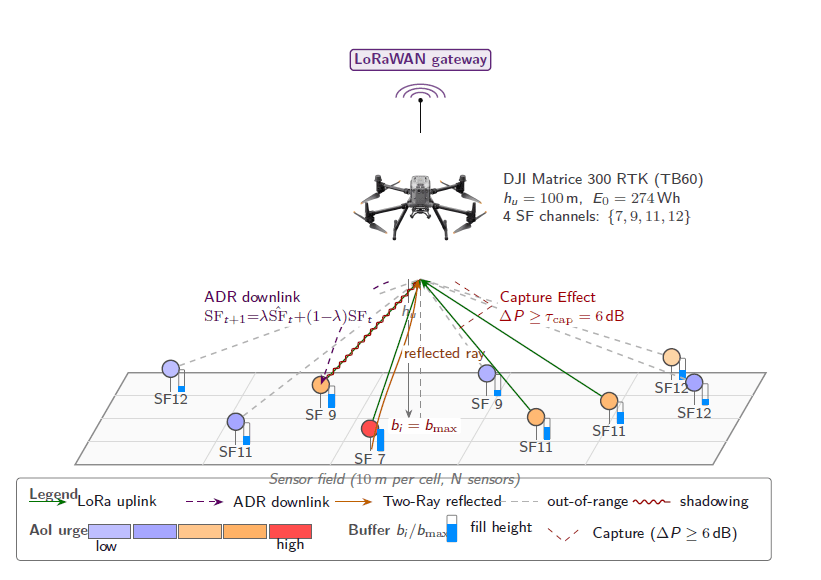
A DQN agent flies a UAV over a 2D grid to collect data from LoRa IoT sensors, balancing throughput, energy, and coverage fairness.
What I built
- Custom Gymnasium environment simulating LoRaWAN physics (Two-Ray path loss, EMA-ADR, AoI)
- DQN with domain randomisation across 16 environment conditions
- Competence-based curriculum learning (NDR >= 95%, Jain fairness >= 0.85)
- 4-frame state stacking with cross-attention sensor encoding
- Full ablation study (A1-A4) with Welch t-tests vs baselines
Results
- 100% sensor coverage, matching the greedy oracle baseline
- 72,590 bytes collected per episode
- Cohen d = 1.43 vs combined ablation
- High first-class grade
Stack
Python 3.11, Stable-Baselines3, PyTorch, Gymnasium, Matplotlib, Seaborn.